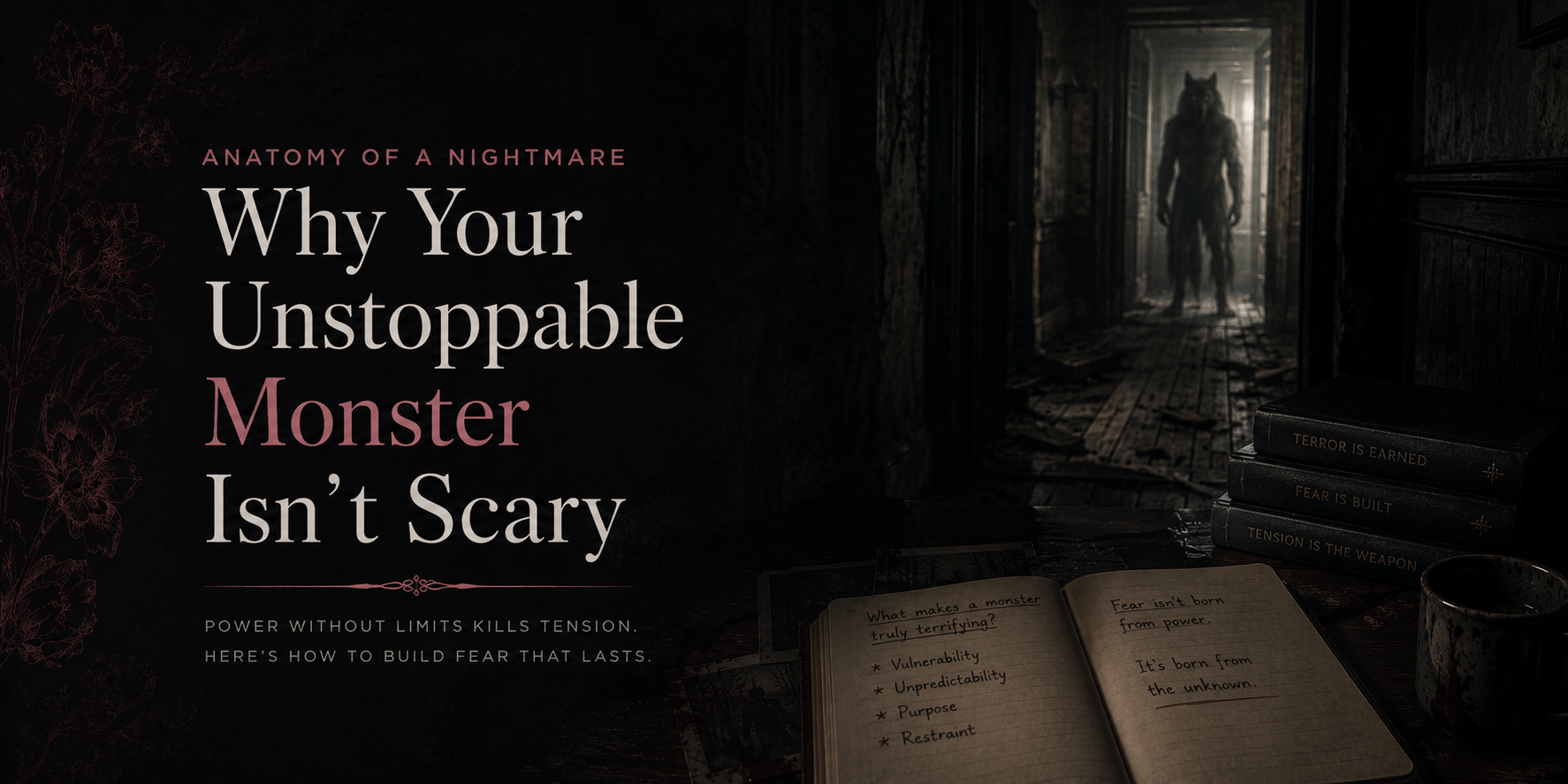
Anatomy of a Nightmare: Why Your Unstoppable Monster Isn't Scary
Raven Editing
The Raven Quill • June 12, 2026
We sit at our desks in the dark fiction wing reading manuscript after manuscript where a writer tries to terrify us with a twelve-foot-tall shadow demon. It can teleport. It can read minds. It breathes acid. It cannot be killed by conventional weapons. And you know what our reaction is? Absolute, mind-numbing boredom.
When writers try to make a creature scary, their first instinct is usually to make it invincible. But a monster without limitations isn't a source of tension; it's just an inevitable game over screen. To make a reader's blood truly run cold, you don't need to give your monster more fangs. You need to give it an Achilles' heel.
1. The Superman Problem
Think about playing a game of chess against a pigeon. It doesn't matter what brilliant moves you make; the pigeon is just going to knock over the pieces and poop on the board. That’s what it feels like reading a horror novel with an omnipotent monster.
If your antagonist can walk through walls, track the protagonist’s scent from fifty miles away, and instantly regenerate lost limbs, you have robbed your protagonist of agency. The reader knows that any escape attempt is fundamentally pointless. And where there is no hope, there is no tension. Tension requires the reader to believe, even just a little bit, that the protagonist might outsmart the beast.
"Fear doesn't come from the certainty of death. Fear comes from the desperate, frantic struggle to survive against impossible—but not entirely broken—odds."
2. The Biological Toll (Make it Hurt)
Every supernatural ability your monster possesses should have a physical, environmental, or psychological cost. Magic shouldn't be clean; it should be messy. If you ground the supernatural in gruesome physical reality, it becomes infinitely more terrifying.
Let's say your monster is a shapeshifter. Don't just have it magically morph into a copy of the protagonist's best friend in a puff of smoke. Make the reader listen to it. Describe the sickening crunch of its collarbone snapping in half to mimic human shoulders. Describe the wet, tearing sound of its vocal cords stretching to perfectly match a human pitch.
- Why this works: By giving the ability a biological toll, you anchor the impossible creature in sensory reality. If the monster suffers to use its power, the reader intuitively understands that the monster has physical limitations. It bleeds. Therefore, maybe it can die.
3. The Predictable Trigger (The Rule of the Game)
The best horror monsters in literary and cinematic history come with an instruction manual written in blood. Vampires burn in the sunlight. The xenomorph's blood melts through spaceship hulls. The monsters in A Quiet Place only hunt by sound.
Why do these arbitrary rules work so well? Because rules allow the reader to participate in the survival game. If the reader knows the monster only attacks in the dark, they will practically scream at the page when the protagonist's flashlight starts to flicker. You are handing the reader the very tool they need to anticipate the danger.
If the monster has no rules, it can attack anywhere, anytime, for any reason. Ironically, that makes the attacks feel random and unearned.
4. The Breadcrumb Reveal
So, you’ve given your monster a weakness and a set of rules. How do you tell the reader? Do not have an old man in a tavern info-dump the lore in chapter two.
Lore should be treated like a forensic investigation. Let the protagonist test the boundaries of the creature through trial and terror. Have them notice that the creature refused to step onto the linoleum floor of the kitchen. Why? Let them theorize. Let them try to weaponize that theory later. When the protagonist figures out a rule through sheer, bloody survival, the reader feels the triumph of the discovery with them.
Final Thoughts from the Editor's Desk
As developmental editors, one of the first things we look for in a horror manuscript is the internal logic of the nightmare. Is your beast a fascinating biological terror, or just a lazy plot device designed to kill teenagers? Give your monster a weakness, define its rules, and watch your readers squirm as your protagonist desperately tries to exploit them.
Is your monster feeling a bit generic?
Designing a terrifying, logically sound monster requires intricate world-building. Don't let your scares fall flat. Let our specialized developmental editors handle the heavy lifting.
View Horror Editing Packages